How Venue-Specific Conditions Shape Outcome Modeling Across Racket Sports and Team Events on Digital Platforms
Jordan Hartmann · Jul 27, 2026
How Venue-Specific Conditions Shape Outcome Modeling Across Racket Sports and Team Events on Digital Platforms
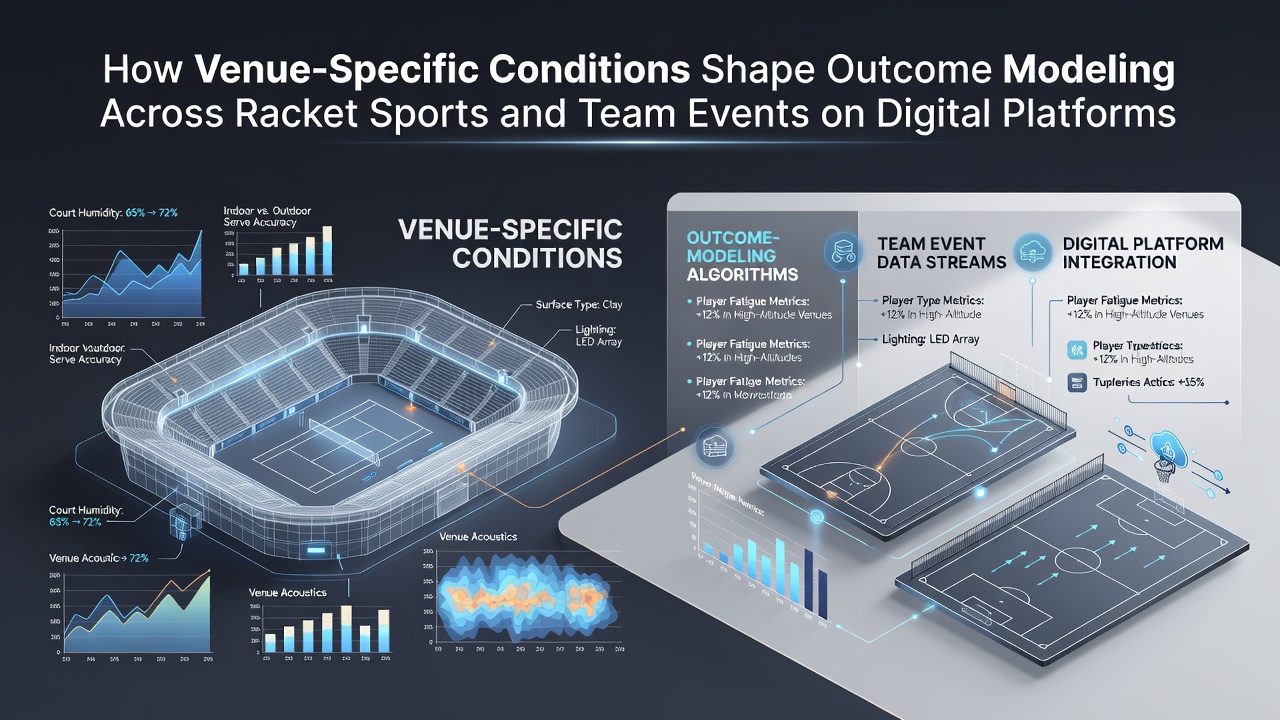
Venue conditions play a direct role in how outcome models process data for racket sports and team events on digital platforms, where algorithms incorporate surface type, altitude, indoor climate controls, and spectator density to refine probability calculations. Platforms adjust inputs for these variables because ball trajectory, player endurance, and team coordination shift measurably from one location to another, and data sets collected across multiple seasons show consistent patterns that improve forecast accuracy when venue details receive explicit weighting.
Venue Factors in Racket Sports Modeling
Tennis surfaces alter bounce height and speed, which forces modelers to segment historical match data by court category before generating predictions for upcoming fixtures. Clay courts slow the ball and produce higher bounces, leading platforms to elevate the projected length of rallies in their calculations, whereas grass courts accelerate play and shorten point duration, prompting downward adjustments to expected game counts. Altitude adds another layer because thinner air at locations such as Bogotá or Johannesburg increases serve speed while reducing spin effectiveness, and July 2026 records from South American clay-court events supplied fresh altitude-corrected statistics that several platforms integrated into live modeling pipelines.
Badminton and table tennis venues introduce humidity and lighting variables that affect shuttlecock flight and table friction respectively. Indoor facilities maintain tighter environmental controls, yet even small differences in air conditioning settings or floor material change coefficient-of-friction values used in simulation engines. Observers note that digital platforms now pull real-time sensor data from venue operators to update these micro-variables during tournaments rather than relying solely on seasonal averages.
Team Event Adjustments on Digital Platforms
Team events such as volleyball and basketball require models to account for court dimension tolerances and crowd acoustics that vary by arena. Professional leagues publish official court specifications, yet minor deviations in boundary padding or lighting rig height still register in tracking systems and influence defensive coverage projections. Platforms incorporate these measurements because blocked shots and rebound percentages fluctuate when teams travel to venues with tighter sidelines or higher ceilings.

Noise levels generated by home crowds correlate with turnover rates in basketball and service error rates in volleyball, according to datasets released by the NCAA research division. Model builders therefore apply venue-specific crowd multipliers derived from attendance figures and decibel recordings rather than uniform league-wide assumptions. In July 2026 several North American arenas released updated acoustic profiles that prompted immediate recalibration of in-game momentum variables across multiple prediction engines.
Data Integration Practices
Digital platforms aggregate venue data from governing bodies and third-party sensors, then feed the information into machine-learning layers that separate location effects from player skill ratings. Australian Sports Commission reports on indoor facility standards have supplied reference values for air-handling systems in badminton halls, allowing models to normalize shuttle speed across continents. European volleyball federations contribute similar specifications for arena dimensions that platforms cross-reference against GPS-tracked player movement logs.
Real-time updates occur when weather stations or venue management systems transmit changes in temperature or humidity, because these shifts alter grip friction and muscle fatigue rates during extended matches. Platforms maintain separate historical buckets for each venue rather than blending all matches into a single pool, which preserves the statistical signal that distinguishes, for example, the faster hard courts at Indian Wells from those at the Australian Open.
Conclusion
Venue-specific conditions continue to supply measurable inputs that digital platforms use to refine outcome models for both racket sports and team events. Surface composition, altitude, lighting, acoustics, and climate controls each receive dedicated weighting because empirical records demonstrate their influence on rally length, error frequency, and scoring margins. As sensor networks expand and governing bodies release additional facility data, platforms gain finer resolution for these adjustments, supporting more granular probability outputs across global competitions.